
Modules and commands
A PRISM model comprises one or more modules, usually representing distinct system components that may interact with each other. A module has two key ingredients: variables, whose values define the state of the module, and commands, which describe how the state of the module evolves over time.
An example DTMC
The following simple example illustrates these basic concepts on a PRISM model that defines a discrete-time Markov chain (DTMC).
// Variant of a random walk

dtmc

module M

	x : [0..3] init 0;
	y : [0..1] init 0;

	[] y=0 & x<3 -> 0.5:(x'=max(x-1,0)) + 0.4:(x'=x+1) + 0.1:(x'=x+1)&(y'=1);
	[] y=0 & x=3 -> true;
	[] y=1 -> (y'=0);

endmodule
The model's type (discrete-time Markov chain) is denoted by the initial dtmc keyword.
It contains one module M whose state is defined by two integer-valued variables x and y,
with ranges [0..3] and [0..1], respectively.
It models a variant of a one-sided, one-dimensional random walk:
it repeatedly randomly increments or decrements the value of x by one, until x reaches value 3.
This only happens when variable y equals 0.
On each increment of x, there is a chance that the value of y is flipped to 1.
It will then be reset to 0 one step later.
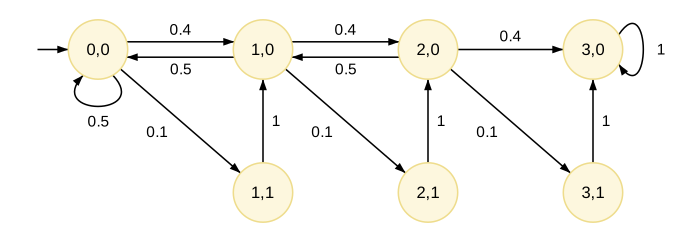
The resulting Markov chain, whose states take the form (x,y), is shown below.
Commands
A module's definition includes its variables, discussed in more detail later, and its commands. Each command comprises a guard and a probabilistic update. The basic form is:
[action] guard -> prob_1 : update_1 + ... + prob_n : update_n;
The guard is a predicate over all the variables in the model,
indicating when the command is enabled.
Each individual update update_i describes a possible outcome of the command being executed,
defined by giving the new values of the module's variables,
with x'=... denoting the new value of variable x.
For a Markov chain, as above, each update update_i is assigned a probability prob_i,
and the probabilities in the command must sum to one.
Commands have an optional action, between the initial pair of square brackets. These have multiple uses, including labelling nondeterministic choices in MDPs and synchronisation between commands in different modules, which are discussed in more detail later. The current example omits actions.
A simple command looks like:
[] x=0 -> 0.8:(x'=1) + 0.2:(x'=2);
which, when variable x has value 0, randomly updates it to either 1 or 2,
with probability 0.8 or 0.2, respectively.
The right-hand side of an update can be an expression
in terms of the current values of the model's variables,
as in the first command of the walk-var.prism example above:
[] y=0 & x<3 -> 0.5:(x'=max(x-1,0)) + 0.4:(x'=x+1) + 0.1:(x'=x+1)&(y'=1);
where (x'=x+1) increments x by 1
and (x'=max(x-1,0)) decrements it by 1, but ensures that it does not go below 0.
Updates to multiple variables are concatenated with &, as in the last update above, which increments x and flips the value of y to 1.
If a variable is not mentioned in an update, its value is assumed to remain unchanged,
i.e., (x'=x+1) above is equivalent to (x'=x+1)&(y'=y).
Thanks to its guard, the command above is enabled whenever y=0 and x<3.
It therefore defines the behaviour for three of the states in the Markov chain shown above:
(0,0), (1,0) and (2,0). For simple Markov chain models like the above,
we will usually assume that the guards are disjoint.
This will usually not be the case for models with nondeterminism
or models with synchronisation between modules.
If there are no enabled commands in some reachable state of the model, this is referred to as a deadlock state. PRISM's default behaviour is to add (probability 1) self-loops to such states and emit a warning.
Updates
If a probability is omitted, it is assumed to be one:
[] y=1 -> (y'=0);
and true is used to denote an empty update where no variable's value changes:
[] y=0 & x=3 -> true;
Changes to multiple variables in an update happen simultaneously.
So, for example, this command updates y to 0, not 1:
[] x=0 & y=0 -> (x'=1)&(y'=x);