
Non-probabilistic models
As well as probabilistic models, PRISM supports non-probabilistic models, in particular labelled transition systems (LTSs). An LTS is like an MDP but without probabilities: in each state, there is a nondeterministic choice between one or more transitions, each of which leads to a single successor state.
LTSs can be used to check functional (rather than quantitative) correctness of a system, using the temporal logics CTL and LTL, for example as a first step before adding probabilities to a model.
Modelling
LTSs are modelled using the usual PRISM language features (modules, variables, commands, synchronisation, formulas, labels, etc.), but with no probabilities attached to the updates of commands. Here is a simple example: two processes, each of which can be idle, trying or in a critical section, which use a lock to ensure mutual exclusion.
// Two processes sharing a lock (no probabilities)

module P1

    x : [0..2]; // 0=idle, 1=trying, 2=critical

    [try1] x=0 -> (x'=1);
    [enter1] x=1 -> (x'=2);
    [exit1] x=2 -> (x'=0);

endmodule

module P2 = P1 [ x=y, try1=try2, enter1=enter2, exit1=exit2 ] endmodule

module Lock

    l : bool; // locked?

    [enter1] !l -> (l'=true);
    [enter2] !l -> (l'=true);
    [exit1] l -> (l'=false);
    [exit2] l -> (l'=false);

endmodule

label "both" = x=2 & y=2;
The two processes do not synchronise with each other,
but each one synchronises
with the Lock module when it enters or leaves its critical section:
for example, the action enter1 can only occur when the lock is free (!l),
and it then sets the lock.
There is no model type keyword for LTSs.
If a model has no keyword (which would usually result in the default model of an MDP) and does not use any probabilities, it is treated as an LTS.
If instead it starts with the mdp keyword, it is treated as an MDP
(in which each choice has a single transition with probability 1).
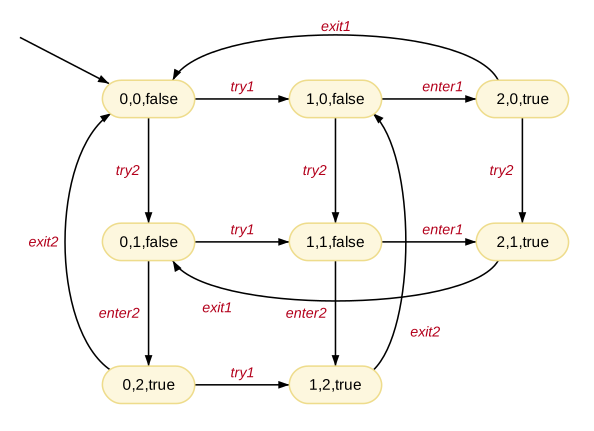
The resulting LTS is shown below, where each state shows the values of x, y and l,
and transitions are labelled with their actions.
Note that the lock is set exactly when one process is in its critical section,
and that there is no state with x=2 and y=2, where both processes are in the critical section.
Properties
LTSs can be analysed with non-probabilistic properties,
i.e., CTL and LTL formulas using the A (for all paths) and E (there exists a path) operators.
For example, for the model above:
// The two processes are never both in the critical section
A [ G !"both" ];

// It is possible for process 1 to reach the critical section
E [ F x=2 ];

// Whenever process 1 is trying, it eventually reaches the critical section
A [ G ((x=1) => (F x=2)) ];
The first two properties are true: the protocol ensures mutual exclusion, and process 1 can reach its critical section. The third is false, since process 2 can repeatedly enter its critical section while process 1 waits forever. PRISM does not make any fairness assumptions about the choices in the model.
For some properties, PRISM also generates a counterexample or witness, e.g., a path along which process 1 reaches its critical section for the second property above.
Solution methods
LTSs are analysed with the explicit engine, which PRISM switches to automatically. CTL properties are checked with standard graph-based algorithms and LTL properties by building the product of the LTS with a Büchi automaton.