
Real-time models
PRISM supports real-time models, in particular, probabilistic timed automata (PTAs), which extend MDPs with the ability to model real-time behaviour. This is done in the style of timed automata [AD94], by adding clocks, real-valued variables modelling the elapse of time.
The state of a PTA is made up of its clocks, plus other variables.
The non-clock part of the state is often called the location of the PTA.
The values of the clock variables are assumed to increase at the same rate, as time elapses.
But the model can also include clock resets, which reset a clock's
value to a (non-negative integer) value, usually 0, at certain points.
Transitions of the model between its locations can be made dependent on the values of the clocks: clock invariants dictate the range of values within which clocks must stay for each location before moving to another location; clock guards can be used to restrict transitions to when clocks have certain values.
For background material on PTAs, see for example [NPS13].
You can also find several example PTA models included in the PRISM distribution. Look in the prism-examples/ptas directory.
Modelling
Here is a simple example of a PTA, modelled in PRISM.
It represents a system that attempts to send a message,
which happens at a time instant in the range [1,2]
and succeeds with probability 0.9.
In the case of failure, it then repeatedly retries to send the message,
waiting for a delay in the range [2,3] each time.
// A simple PTA model with a single clock x

pta

module M

    s : [0..2] init 0; // 0=send, 1=success, 2=retry
    x : clock;

    invariant
        (s=0 => x<=2) &
        (s=2 => x<=3)
    endinvariant

    [send] s=0 & x>=1 -> 0.9:(s'=1)&(x'=0) + 0.1:(s'=2)&(x'=0);
    [retry] s=2 & x>=2 -> 0.95:(s'=1) + 0.05:(s'=2)&(x'=0);

endmodule
The model type is indicated as pta at the top of the file
(in fact PRISM will also detect an MDP model with clock variables and treat it as a PTA).
Clocks use the variable type clock, and are declared in the same way as other variables.
This example uses a single clock variable x.
Other variables can be declared in the usual way and make up the rest of the state of the model (its location).
In the example above, we use just a single integer variable s with range [0..2].
Clock guards are embedded within the usual guarded command notation
(see, for example, the inclusion of x>=1 in the guard for the send-labelled command).
Clock resets are included with the variable updates of commands
(see, for example, the instances of (x'=0) in the example).
Additionally, an invariant construct in each module, placed after its variable declarations,
specifies clock invariants as an expression over clocks and other variables.
The format used in the example (a conjunction of implications)
is a convenient way to specify a separate clock invariant for each PTA location.
In the example, the clock x must satisfy x<=2 or x<=3
when local variable s is 0 or 2, respectively.
If s is 1, there is no restriction
(since the invariant is effectively true in this case).
The resulting PTA is shown below, where states (locations) are identified by the value of s.
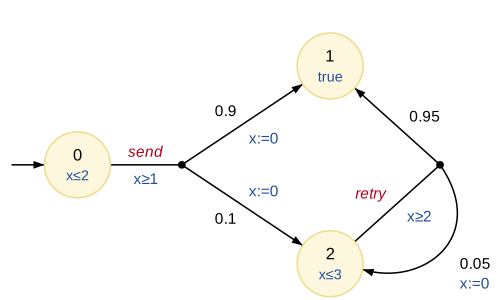
Rewards: PTA models can include reward structures in the same way as MDPs. However, the reward structures for PTAs are restricted to only include state and transition rewards that do not depend on clock variables. Formally, the class of PTAs with this kind of reward structure is sometimes called linearly priced PTAs (see e.g. [KNPS06]).
Restrictions:
Expressions in PTA models that include reference to clocks, whether in guards or invariants, must satisfy certain conditions to facilitate model checking. In particular, references to clocks must appear as conjunctions of simple clock constraints, i.e., conjunctions of expressions of the form x~c or x~y where x and y are clocks, c is an integer-valued expression and ~ is one of <, <=, >=, > or =.
PRISM makes several assumptions about PTAs, regardless of the engine used.
-
Firstly, PTAs should not exhibit timelocks, i.e., the possibility of reaching a state where no transitions are possible and time cannot elapse beyond a certain point (due to invariant conditions). PRISM checks for timelocks and reports an error if one is found.
-
Secondly, PTAs should be well-formed and non-zeno (see e.g. [KNSW07] for details). PRISM does not check automatically that these assumptions are satisfied.
There are also some further restrictions, which depend on the engine used: see below.
Properties
The classes of property that can be checked for real-time models are more restricted than for the other kinds of models that PRISM supports. This is because the model checking procedures are quite different for this type of model. The situation also depends on which of the engines is being used.
Broadly speaking, PRISM allows single (non-nested) instances of unbounded or time-bounded probabilistic reachability properties and reachability reward properties, i.e., queries of the form:
Pmin=? [ F target ]
Pmax=? [ F target ]
Pmin=? [ F<=T target ]
Pmax=? [ F<=T target ]
Rmin=? [ F target ]
Rmax=? [ F target ]
where target is a Boolean-valued expression that does not include
references to any clock variables and T is an integer-valued expression.
In some cases (see below), PRISM also allows until (U) properties.
Solution methods
PRISM has three distinct engines that can be used for analysing PTAs.
-
The stochastic games engine uses abstraction-refinement techniques based on stochastic two-player games [KNP09c].
-
The digital clocks engine performs a discretisation, in the form of a language-level model translation, that reduces the problem to one of model checking over a finite-state MDP [KNPS06]. If you want to see the MDP PRISM model that was generated, add the switch
-exportdigital digital.prismwhen model checking a property to export the model file todigital.prism. -
The backwards reachability engine is a zone-based method based on a backwards traversal of the state space and solution of the resulting finite-state MDP [KNSW07].
The default engine for PTAs is "stochastic games". The engine to be used can be specified using the "PTA model checking method" setting in the "PRISM" options panel in the GUI. From the command-line, switch -ptamethod <name> should be used where <name> is either games, digital or backwards.
Restrictions: The choice of engine affects the models that can be analysed, as well as the properties that can be checked.
For the stochastic games and backwards reachability engines:
- The model must have a single initial state (i.e., the
init...endinitconstruct is not permitted). - Only
Pmin=?andPmax=?queries are supported (not, e.g.,P>=0.9); reward properties are not supported. - Filters and the
"init"and"deadlock"labels cannot be used in properties.
Additionally, for the backwards reachability engine:
- Only maximum probabilities are handled.
For the digital clocks engine:
- Until (
U) formulas are also allowed in thePoperator, in addition to reachability (F) formulas. - Properties can refer to clock variables, so
targetis not restricted as above. - Arithmetic expressions in properties, such as
1 - Pmin=? [ F target ], are allowed. - Clock constraints in both models and properties
cannot use strict comparison operators
(e.g.,
x<=5is allowed, butx<5is not). - In both models and properties, diagonal clock constraints are not allowed,
i.e., those containing references to two clocks, such as
x<=y.