
Uncertain models
PRISM has support for uncertain models, in which there is epistemic uncertainty regarding some quantitative aspects of the probabilistic models being verified. In particular, it supports interval MDPs (IMDPs) and interval DTMCs (IDTMCs), which are MDPs or DTMCs in which transition probabilities are specified as intervals, indicating that the exact probability is not precisely known. This can be useful, for example, when the transition probabilities have been estimated from data.
You can find some example models included in the PRISM distribution.
Look in the prism-examples/imdps and prism-examples/idtmcs directories.
Modelling
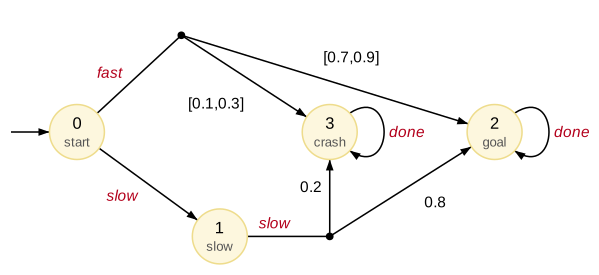
Here is a simple example of an IMDP, modelled in PRISM.
A robot can choose between two routes to a goal:
a fast route, whose probability of success is only known to lie in the range [0.7,0.9],
and a slower route, whose probability of success is known to be 0.8.
// A simple IMDP: a robot chooses between a fast route with
// an uncertain chance of success and a slower but reliable one

mdp

module M

    s : [0..3]; // 0=start, 1=slow route, 2=goal, 3=crash

    [fast] s=0 -> [0.7,0.9]:(s'=2) + [0.1,0.3]:(s'=3);
    [slow] s=0 -> (s'=1);
    [slow] s=1 -> 0.8:(s'=2) + 0.2:(s'=3);
    [done] s>=2 -> true;

endmodule

label "goal" = s=2;
Intervals are used by simply replacing the probabilities attached to updates in commands
with intervals, such as [0.7,0.9] above.
Single values (e.g., 0.8 in the example) are treated as single-point intervals ([0.8,0.8]).
There is no separate model type keyword for interval models:
a dtmc or mdp model containing intervals is treated as an IDTMC or IMDP, respectively.
Intervals can also be used in POMDPs, giving interval POMDPs (IPOMDPs),
but these can only be built, not model checked.
The resulting IMDP is shown below.
As usual, the interval bounds can be expressions involving constants or state variables, for example:
[] x=0 -> [p,p+0.1]:(x'=0) + [0.9-p,1-p]:(x'=1);
The intervals in each command must allow at least one probability distribution, i.e., the lower bounds must sum to at most 1 and the upper bounds to at least 1. PRISM checks this when the model is built and reports an error otherwise.
When two commands in different modules synchronise and specify the probabilities for updates to variables as intervals, these are considered to be independent, i.e., the probability of each combined transition is taken to be the product of the two component intervals.
Properties
For uncertain models, PRISM performs robust verification, which considers the best- or worst-case behaviour that can arise depending on the way that probabilities are selected from intervals.
For example, instead of a property for a DTMC such as
P=? [ F "goal" ]
which asks for the probability to reach a state satisfying "goal", IDTMCs use MDP-style queries:
Pmin=? [ F "goal" ]
Pmax=? [ F "goal" ]
which compute the minimum or maximum possible probability that can arise.
For an IMDP, there are two separate quantifications,
firstly over strategies (policies) and secondly over the distinct ways
that transition probabilities can be selected from intervals.
For these, min or max appear in that order in the query.
For example, for the IMDP above:
// Maximum probability of reaching the goal (worst case)
Pmaxmin=? [ F "goal" ];

// Maximum probability of reaching the goal (best case)
Pmaxmax=? [ F "goal" ];
The first property asks for the maximum probability of reaching the goal,
assuming the worst case for the uncertain probabilities;
the result is 0.8, achieved by taking the slow route.
The second assumes the best case instead;
the result is 0.9, achieved by taking the fast route.
Similarly, minmin and minmax are used for the minimum probability of reaching "goal".
If only one of min or max is given (e.g., Pmax=?), it is used for both.
Model checking is supported for:
- the
Poperator, including single temporal operators and LTL formulae - the
Roperator, for the expected reward to reach a target or satisfy a co-safe LTL formula, or total (possibly discounted) reward
Solution methods
Uncertain models are analysed with the explicit engine,
which PRISM switches to automatically.
The method used is robust value iteration,
which is like the value iteration used for MDPs,
except that each iteration also finds the best or worst probabilities within the intervals.
By default, the Gauss-Seidel variant is used;
standard value iteration can be selected with the -valiter switch
(or the "IMDP/DTMC solution method" setting in the GUI).
Strategies can be generated and exported for IMDPs as for MDPs.
For the example above, the strategy chooses slow in state 0 for Pmaxmin=?
and fast for Pmaxmax=?.