
Actions and nondeterminism
The examples presented so far have been DTMCs, which means that each state has one or more outgoing transitions with associated probabilities that sum to one. Another core model type supported by PRISM is the Markov decision process (MDP), which allows for nondeterminism in the model. In this case, each state can have several choices, each of which defines a probability distribution over successor states. Often, but not always, these choices are labelled with actions.
In the PRISM language, nondeterminism can be modelled by allowing the guards of its commands to overlap. Each enabled command in a state defines a separate choice, and its (optional) action label is specified using the square brackets at the start of the command.
An example MDP
The following example represents a classic MDP, the "chain" model [Str00].
There are N states in a chain, and in each one there are two possible actions:
a, which moves one step along the chain, and b, which goes back to the start.
But actions are not completely reliable:
with probability slip, the other action happens instead.
// A "chain" MDP: At each step, choose action a (move along the chain) or b
// (go back to the start), but with probability slip, the other one happens

mdp

// Number of states in the chain
const int N = 4;
// Probability that the chosen action slips
const double slip = 0.2;

module chain

	s : [0..N-1] init 0;

	[a] true -> 1-slip : (s'=min(s+1,N-1)) + slip : (s'=0);
	[b] true -> 1-slip : (s'=0) + slip : (s'=min(s+1,N-1));

endmodule
The keyword mdp indicates that the model is an MDP.
The module has a single variable s representing the position in the chain,
which ranges from 0 to N-1 using a constant N (here, 4).
The two commands have the guard true, so both are enabled in every state.
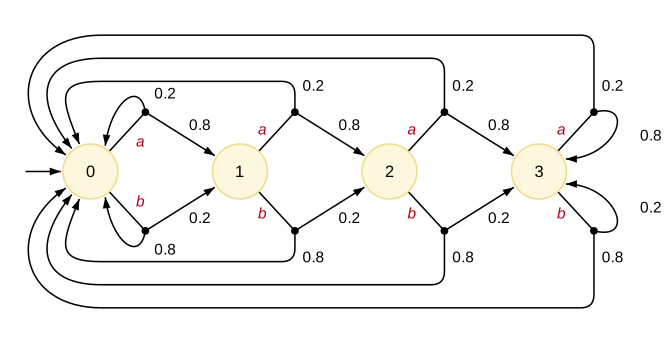
In the resulting MDP, each state has two choices, labelled a and b.
For example, in state s=0, there are two choices:
a: move to states=1with probability 0.8, or stay ins=0with probability 0.2b: stay ins=0with probability 0.8, or move to states=1with probability 0.2
The full MDP is shown below, where each state is labelled with its value of s.
Actions
The commands above are labelled with actions a and b, written between the square brackets, e.g.:
[a] true -> 1-slip : (s'=min(s+1,N-1)) + slip : (s'=0);
For an MDP, these actions play several roles. Firstly, they allow the definition of policies (referred to as "strategies" in PRISM), specifying which action to take in each state in order to satisfy or optimise some property. Actions can also be used (for all model types, not just MDPs) to define rewards and to enforce synchronisation between commands in different modules.
However, actions are optional.
For an MDP, omitting them from a command ([]) results in unlabelled choices.
For example these commands:
[] x<5 -> (x'=x+1);
[] x>2 -> (x'=x-1);
result, in states x=3 and x=4, in two unlabelled choices incrementing or decrementing x.
In similar fashion, PRISM allows the definition of MDPs in which the choices from a state have the same action (technically, this is a probabilistic automaton [Seg95], rather than an MDP):
[a] x<5 -> (x'=x+1);
[a] x>2 -> (x'=x-1);
[b] x=3 -> true;
In both cases (unlabelled choices and duplicate actions), restrictions may then be imposed on the generation of policies/strategies.
Local nondeterminism
We refer to the nondeterminism arising from overlapping guards in a single module as local nondeterminism. In MDPs comprising multiple modules, nondeterminism also arises due to the concurrent interleaving of its commands' execution.
In models that do not include nondeterminism, overlapping guards are treated differently. In particular, in a DTMC, if several commands are enabled in a state, it is assumed that one of them is picked uniformly at random. For example, given the following model:
dtmc

module M

    x : [0..3] init 0;

    [] x=0 -> 0.1:(x'=1) + 0.9:(x'=2);
    [] x=0 -> (x'=3);
    [] x>0 -> true;

endmodule
the first two overlapping commands result in state x=0 of the DTMC
having three outgoing transitions, to states x=1, x=2 and x=3,
with probabilities 0.05, 0.45 and 0.5, respectively.