Dynamic power management: results for the 4-state Fujitsu disk drive
(Qiu, Wu and Pedram)
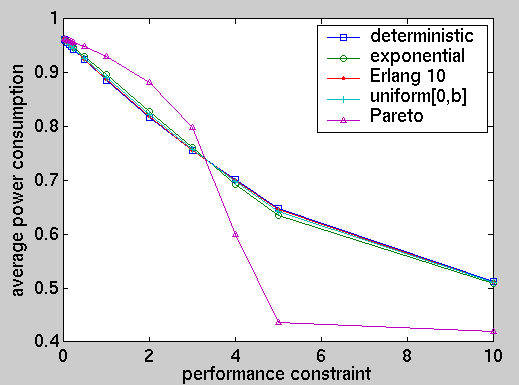
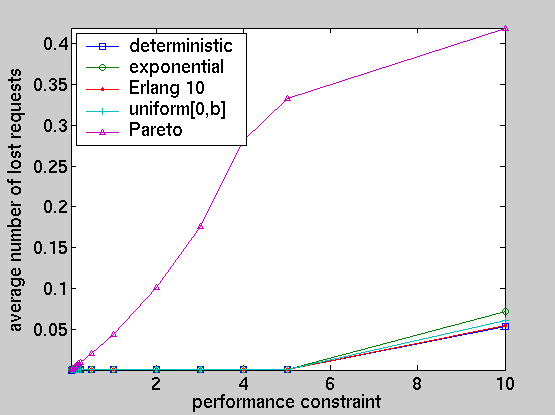
Using the results presented in [KNP02d], we have computed, for the optimal policies under different performance constraints and for a of selection distributions (deterministic, exponential, Erlang, uniform and Pareto), with the same mean (0.72), modelling the inter-arrival time of requests:
Long-run Average Measures:
- the average power consumption;
- the average number of requests awaiting service;
- the average number of lost requests.
Transient Measures:
- the expected power consumption when the Nth request arrives: constraint=10, constraint=5, constraint=2, constraint=1, constraint=0.1, constraint=0.05;
- The expected number of requests awaiting service when the Nth request arrives: constraint=10, constraint=5, constraint=2, constraint=1, constraint=0.1, constraint=0.05;
- the expected number of lost requests when the Nth request arrives: constraint=10, constraint=5, constraint=2, constraint=1, constraint=0.1, constraint=0.05;
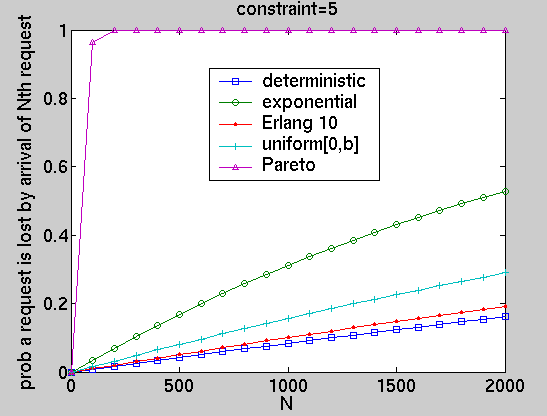
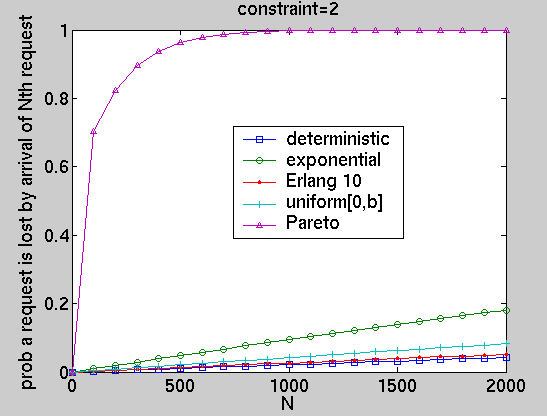
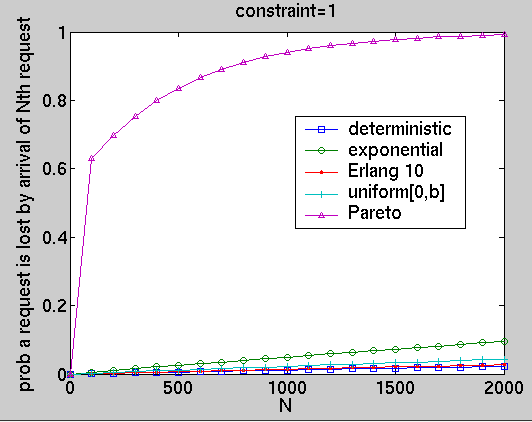
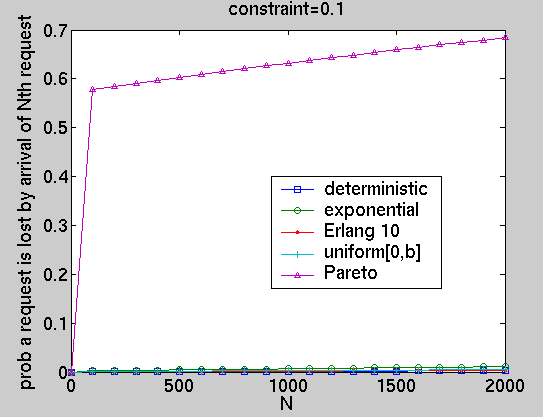
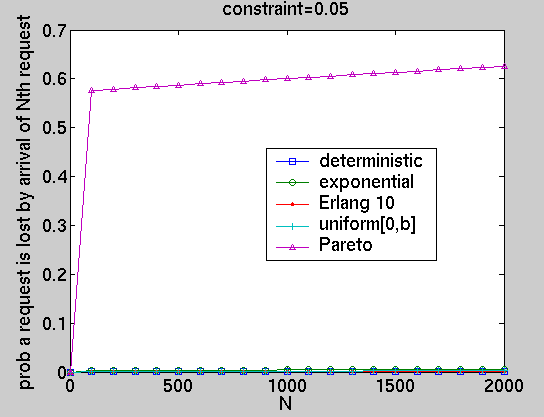
- the probability a request is lost by the time the Nth request arrives: constraint=5, constraint=2, constraint=1, constraint=0.1, constraint=0.05;
- the probability, from the state where the SP is in standby and there are no requests awaiting service, that at least K requests are awaiting service by the time the Nth request arrives K=10: constraint=5, constraint=2, constraint=1, constraint=0.1, constraint=0.05 K=15: constraint=5, constraint=2, constraint=1, constraint=0.1, constraint=0.05.
Furthermore, restricting the inter-arrival time to be exponentially distributed, we have computed the following transient performance measures for the optimal policies under different constraints:
- the expected power consumption by time T;
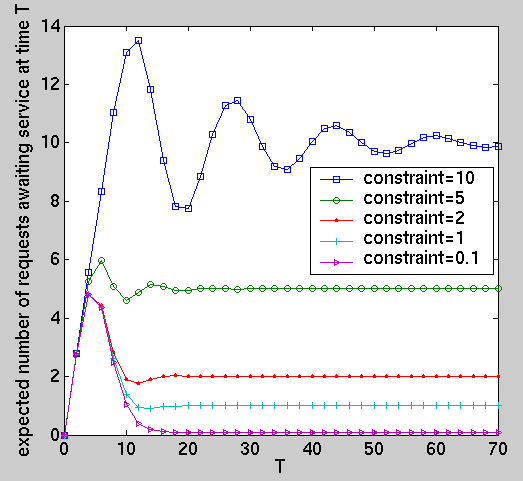
- the expected number of requests awaiting service at time T;
- the expected number of lost requests by time T;
- the probability, from the state where the SP is in standby and there are no requests awaiting service, that at least N requests are awaiting service by time T: see here for the case when N=10 and here for N=15;
- the probability that a request is served by time T, given that it arrived into a certain position in the queue and that the SP is in standby when the request arrives: see here for the the case when the request arrives into the first position in the queue, here for the request arriving into the 5th position and and here when it arrives into the 10th position in the queue;
- from the state where the SRQ is empty and the SP is in standby, the probability that a request gets lost by time T.